The Green Veil: Druids, Warriors, and the Otherworld
Celtic mythology does not draw a line between this world and the next. It draws a veil — thin as morning mist, permeable as a dream. Step through it, and you may never come back the same.
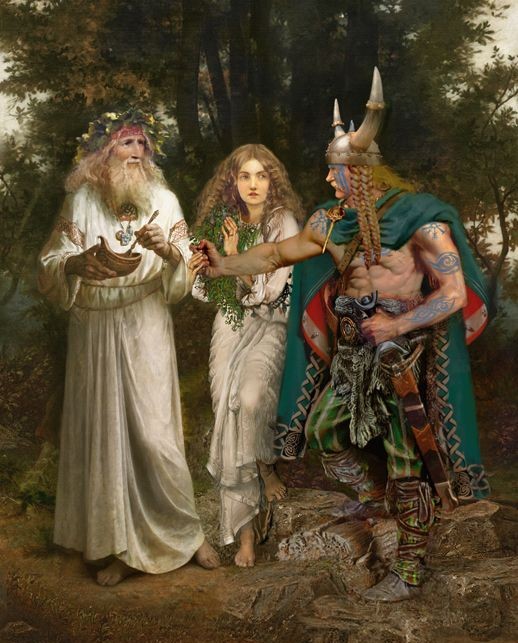
The Celts did not build temples. They walked into forests and called them sacred. They stood beside rivers and heard voices. Their gods did not live on mountaintops — they lived in the spaces between. Between the oak and the stone. Between the seen and the unseen. Between one breath and the next.
"The Celtic world has no walls. It has thresholds — and the bravest souls are the ones who step across them."
The Morrigan: War Is Not What You Think
She appears as a crow on the battlefield. Sometimes three women. Sometimes one. The Morrigan is not a war goddess in the way Ares is — she does not cause war. She witnesses it. She chooses who lives and who falls, not out of cruelty, but out of a terrible necessity that mortals cannot understand.
In some stories, she washes bloodied armor by the river before the battle has even begun. She already knows the outcome. She grieves it. And then she lets it happen anyway, because that is what sovereignty demands.
Our Morrigan pendant carries that paradox — the crow's feather and the queen's crown, death and authority woven into a single symbol. It is not for those who glorify violence. It is for those who understand that sometimes the hardest act of power is allowing.
Brigid: The Flame That Heals
Goddess of poetry, smithcraft, and healing — three disciplines that seem unrelated until you realize they are all acts of transformation. The poet transforms silence into meaning. The smith transforms ore into blade. The healer transforms suffering into recovery.
Brigid's flame was tended by nineteen priestesses in Kildare, each taking a turn through the night. On the twentieth night, the flame tended itself. The fire that needs no keeper. The light that sustains itself.
"Brigid does not burn to destroy. She burns to illuminate. There is a forge inside every act of creation, and she is the one who lights it."
The Otherworld Is Not Heaven
The Celtic Otherworld — Tir na nOg, the Land of the Young — is not a reward for the good. It is a parallel. It exists alongside this world, separated only by a veil that thins at certain moments: at dawn, at dusk, at Samhain, at the turn of the year.
Heroes who cross over do not find peace. They find intensity. Colors are brighter. Music is sharper. Love is deeper. But time moves differently there. A year in the Otherworld may be a century here. You return to find everyone you loved has turned to dust.
Celtic jewelry carries that bittersweetness. The knotwork has no beginning and no end — because in Celtic thought, nothing truly ends. It just crosses a threshold and becomes something else.
"The Celts did not fear the Otherworld. They feared forgetting how to find the door."
Celtic Mythology Pieces
Handcrafted pendants inspired by the legends in this story


Morrigan Pendant


Morrigan Pendant


Boudica Pendant


Saint Brigid Pendant


Melangell Pendant


Boudica Pendant


Queen of Spades Pendant