Where It All Began: The First Gods
Before Greece, before Egypt, before the written word itself — Mesopotamia carved its gods into clay tablets and dared the universe to argue. These are the oldest stories humanity has ever told.
Five thousand years ago, between two rivers — the Tigris and the Euphrates — someone pressed a reed into wet clay and wrote the first story ever recorded. It was not a receipt. It was not a law. It was a myth. The Epic of Gilgamesh. A king who could not accept death. A journey that changed nothing and everything.
"Mesopotamia did not discover writing to count grain. It discovered writing to remember its gods. Commerce was the excuse. Mythology was the reason."
Ishtar Descended into Hell — By Choice
The goddess of love and war walked through seven gates into the underworld. At each gate, she surrendered something: her crown, her jewelry, her robe, her dignity. By the time she reached her sister Ereshkigal — queen of the dead — Ishtar was naked. Stripped of every symbol of power.
Why would the most powerful goddess in the Mesopotamian pantheon willingly humiliate herself? Because she understood something that most power-holders never learn: you cannot rule the living until you have faced the dead. Authority without vulnerability is just tyranny.
Our Ishtar pendant captures that moment of descent — not the triumphant goddess, but the stripped one. The one who chose to be powerless in order to understand power.
Gilgamesh: The King Who Failed
He was two-thirds god, one-third man. He built the walls of Uruk. He killed the Bull of Heaven. He traveled to the end of the world to find the secret of immortality — and he lost it. A serpent stole the plant of eternal youth while Gilgamesh bathed in a pool.
This is the oldest story in the world, and its message is devastating: you cannot cheat death. Not with strength. Not with kingship. Not with the blood of gods in your veins. The only immortality available to humans is the one we build — in walls, in words, in the memories of those who loved us.
"Gilgamesh returned to Uruk empty-handed and looked at his city walls and understood, for the first time, that they were enough."
The Lamassu: Guardians at the Gate
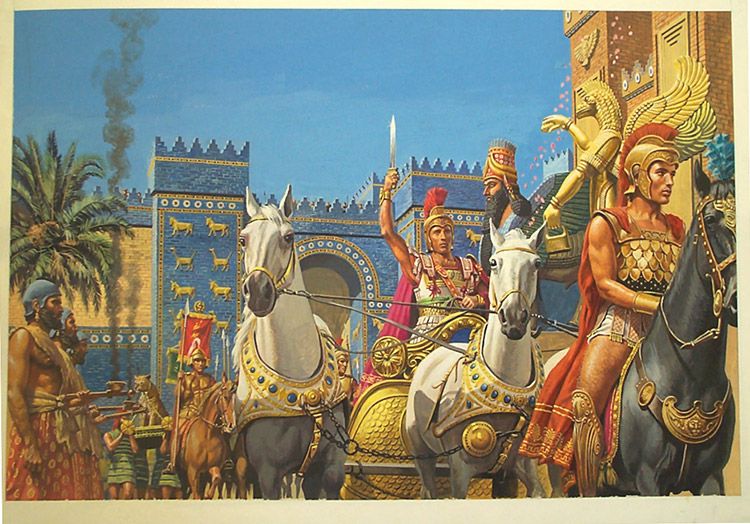
Winged bulls with human faces. They stood at the entrances of Assyrian palaces — massive, impossible creatures carved from single blocks of stone. Five legs, so they appeared to be standing still from the front and walking from the side. A trick of perspective that took master sculptors months to execute.
The Lamassu did not guard against armies. They guarded against chaos. Against the formless void that existed before the gods imposed order on the universe. Every threshold is a border between the known and the unknown. The Lamassu stands at that border and says: not today.
When we design Mesopotamian pieces, we think about those thresholds. The jewelry sits at the border between skin and air, between the wearer and the world. Each pendant is a small Lamassu — a guardian you carry with you.
Why Mesopotamia Matters Now
Because these are the source codes. Every flood myth traces back to Utnapishtim. Every hero's journey echoes Gilgamesh. Every descent-and-return story mirrors Ishtar. When you hold a Mesopotamian pendant, you hold the root of storytelling itself.
"Before the Greeks dreamed of Olympus, before the Norse imagined Valhalla — there was Babylon. There was the ziggurat. There was a people who looked at the stars and decided they were not far enough away."
Mesopotamian Mythology Pieces
Handcrafted pendants inspired by the legends in this story


Nergal & Ereshkigal Pendant


Inanna Pendant


Anzu Pendant


Ereshkigal Pendant


Inanna Pendant


Dumuzid Pendant


Dumuzid Pendant